The Cloud IDE, SPICE Simulator & PCB Designer for Embedded Engineering
Design analog and digital circuits in real-time, compile firmware instantly in WebAssembly, emulate 8051, AVR, ARM Cortex-M0+ and PIC architectures with sub-microsecond cycle accuracy, and teach electrical engineering with automated grading.
P1.0 (GPIO)
Everything Needed from Circuit to Silicon
A unified platform eliminating the friction between electronic schematic design, firmware development, hardware emulation, and PCB fabrication.
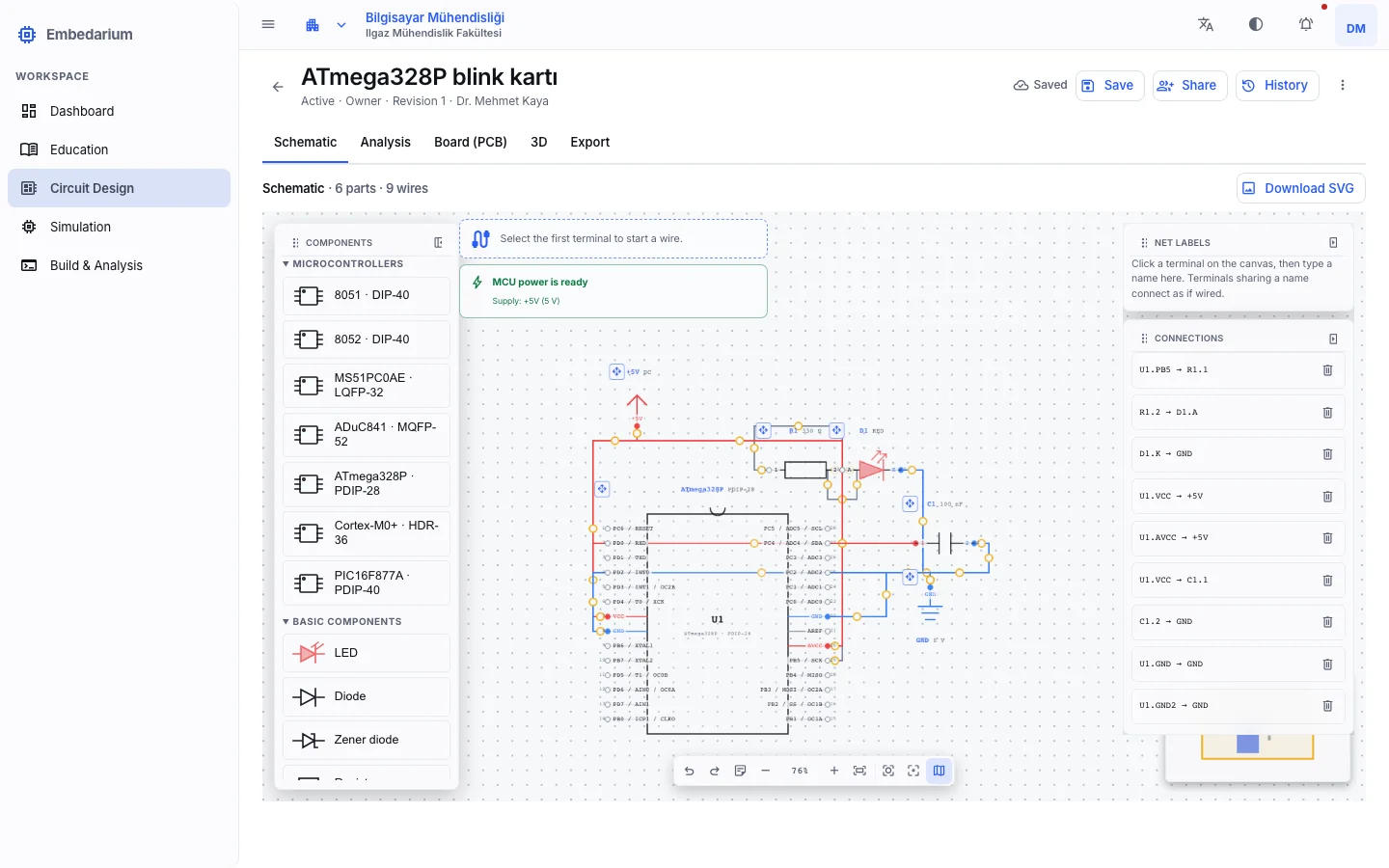
Real-Time Analog & Digital SPICE Solver
Simulate components at the physical and semiconductor level. Calculate nonlinear operating points, transient time responses, and AC Bode frequency plots directly in your browser.
- Shockley Diode & Transistor Models: Exact non-linear junction currents and thermal voltages.
- Virtual Net Labels: Wire-free schematics with automatic net consolidation and ERC verification.
- AC Bode & Transient: Frequency domain analysis, 3dB cutoff calculation, and step responses.
Cycle-Accurate Microcontroller IDE & Debugger
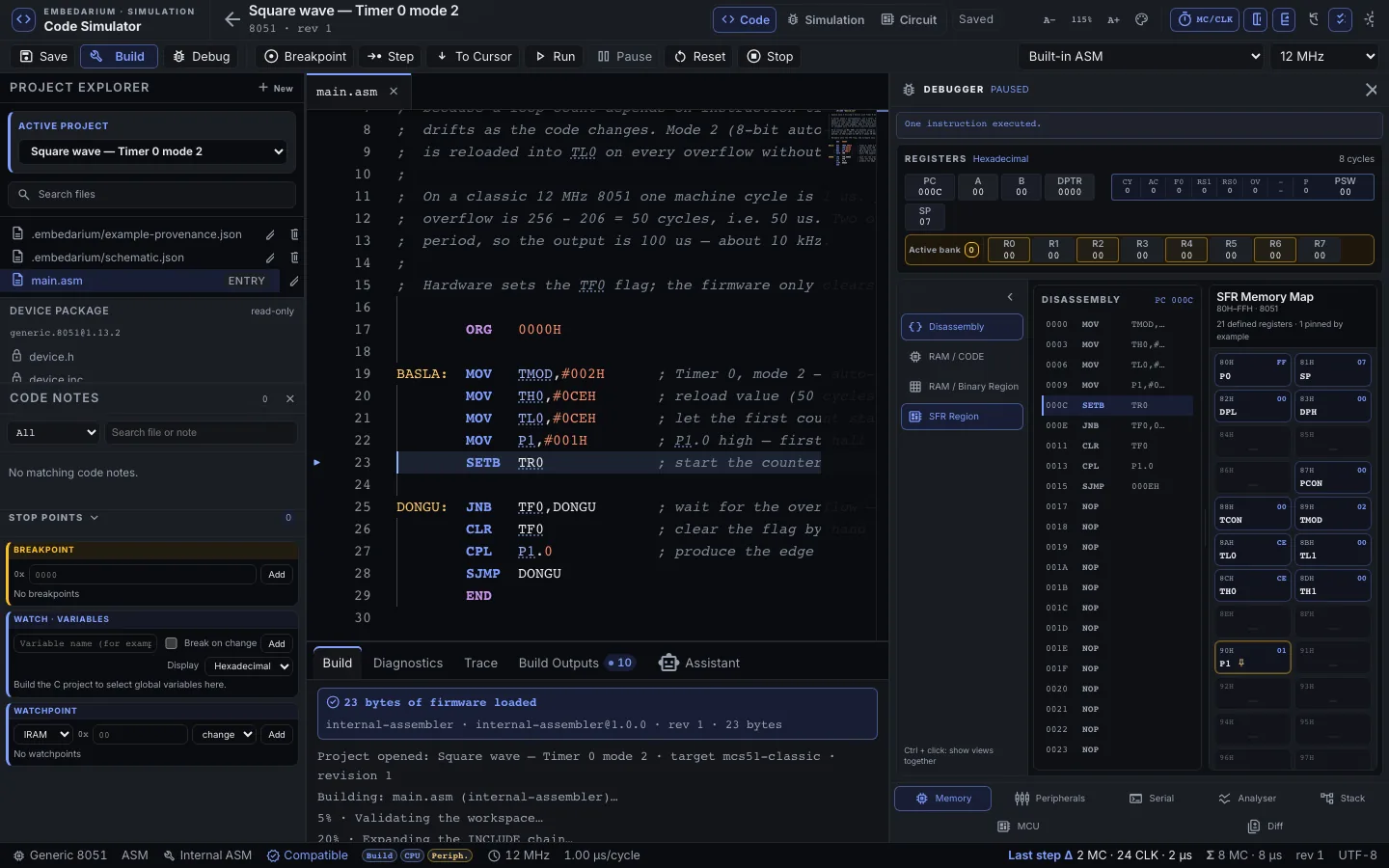
Write C and Assembly in a Monaco-powered cloud editor with zero installation. Step through code, inspect Special Function Registers (SFRs), set conditional watchpoints, and verify hardware timings.
- 7 Architectures Supported: Intel 8051/8052, Nuvoton MS51 1T, ADuC841, AVR ATmega328P, ARM Cortex-M0+, and PIC16F877A.
- Register-Level Transparency: Live view of SREG, PSW, dual DPTR, timers, interrupt priority, and supervisor BOD/WDT.
-
Conditional Breakpoints: Pause on expressions like
R6 == 3, hit counts, or variable watchpoints.
Virtual Instruments & Interactive Hardware Lab
Ditch expensive physical benches or supplement hands-on labs with digital twins. Measure signals with an oscilloscope, analyze UART protocols, and interact with real components.
- Dual-Channel Digital Oscilloscope: Calibrated voltage per division, timebase (1µs to 500ms), and freeze modes.
- Multi-Channel Logic Analyzer: Timing markers, edge triggers, and IEEE 1364 VCD export.
- Physical Interactive Controls: 4x4 Keypads, 7-Segments, potentiometers, relays, DIP switches, and DC motors.
From Schematic to 2-Layer Auto-Routed PCB
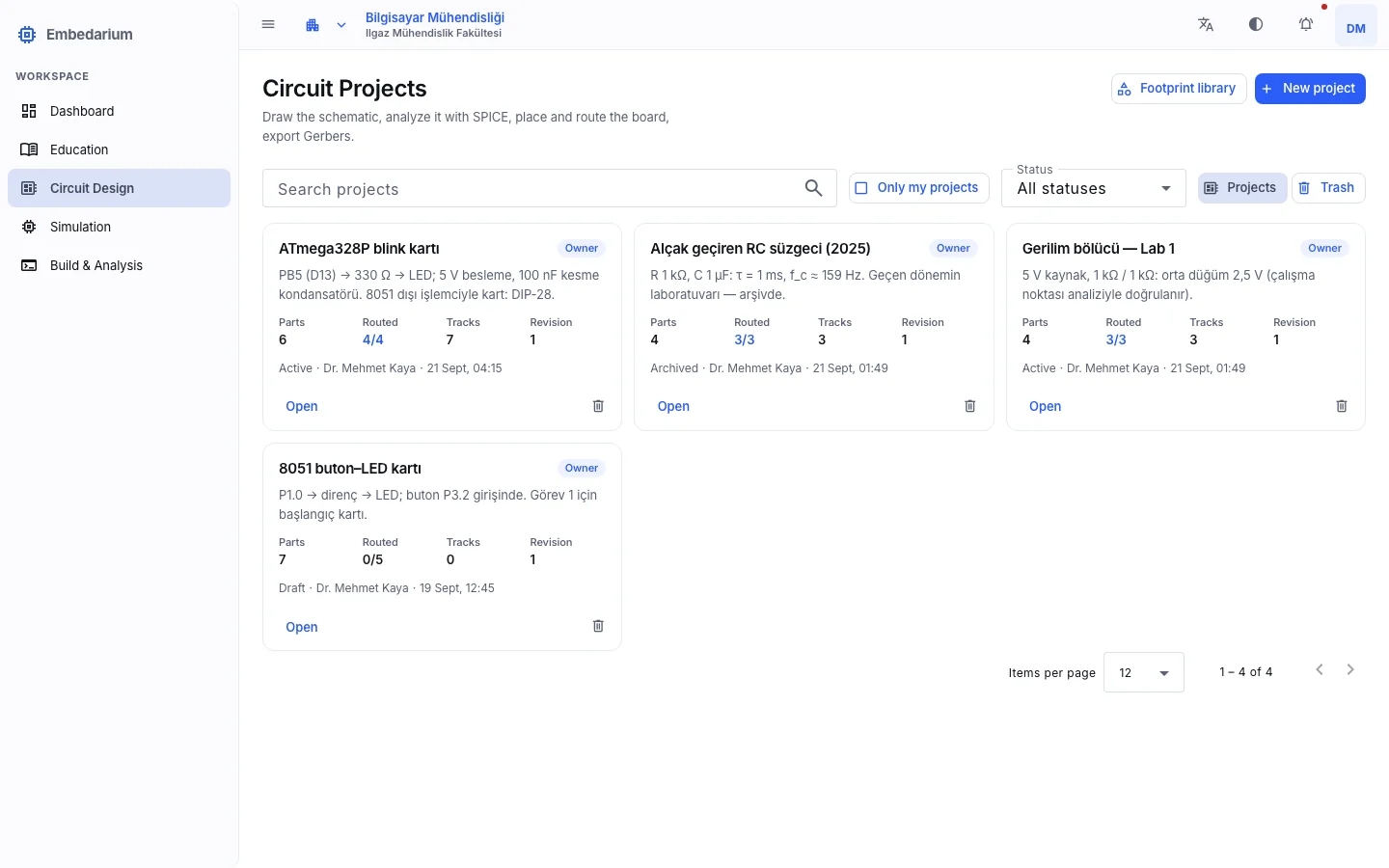
Transform functional schematics into production-ready printed circuit boards. Route traces automatically with DRC constraint checking, inspect 3D components, and export standard manufacturing packages.
- Topological Net Auto-Router: Solves 2-layer track layouts with ground fills, vias, and clearance enforcement.
- 3D Board Visualizer: Interactive 3D view of copper traces, silkscreen labels, and component packages.
- Turnkey CAM Export: RS-274X Gerber, Excellon drill, Bill of Materials (BOM), and Centroid Pick-and-Place (CPL).
Turnkey Engineering Classroom & Auto-Grading
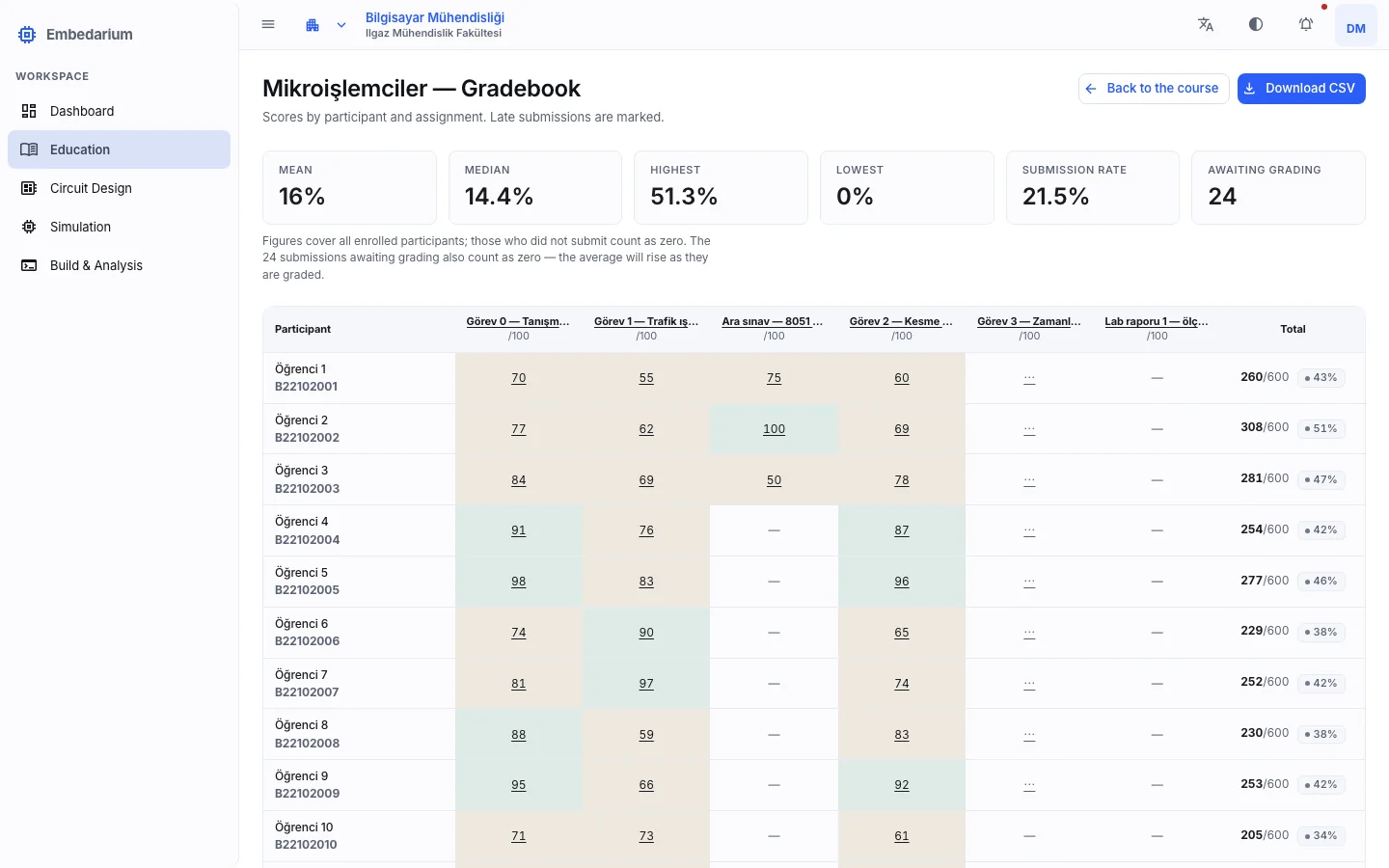
Purpose-built for engineering universities and technical institutes. Assign programming and hardware labs with automated test vectors, anti-plagiarism checks, and rubric grading.
- Automated Simulation Oracles: Evaluates student firmware and circuit outputs against instructor test benches.
- Code Plagiarism Engine: Winnowing k-gram fingerprinting specifically tuned for C and Assembly coursework.
- LTI 1.3 & Grade Sync: Seamless integration with Canvas, Moodle, and Blackboard LMS platforms.
Engineered for Accuracy and Speed
Discover the technical advantages that make Embedarium the premier choice for universities, research labs, and hardware teams.
Microcontroller Emulation
Cycle-accurate instruction execution for 8051, AVR ATmega328P, ARM Cortex-M0+, and PIC16F877A with full interrupt, timer, and SFR emulation.
Real-Time SPICE Solver
Modified Nodal Analysis (MNA) engine executing DC bias point, transient $RC/RLC$ discharge, and AC frequency response directly in the browser.
Virtual Lab Instruments
High-contrast digital oscilloscope and multi-channel logic analyzer with calibrated timebase, voltage divisions, trigger cursors, and VCD export.
PCB Auto-Routing & CAM
Topological 2-layer PCB router with automated ground planes, clearance checks, 3D component view, and fabrication-ready Gerber/drill bundles.
Classroom & Auto-Grading
Course management with assignment timelines, late penalty algorithms, submission history, automated simulation test suites, and gradebooks.
Enterprise Zero Trust Stack
Deploy on your own Linux hardware with single-command Docker installer, Caddy automated TLS, Cloudflare Zero Trust Tunnel, and TOTP MFA.
Multi-Tier Web & Compiler Engine
How Embedarium achieves sub-microsecond cycle accuracy and instantaneous browser compilation while maintaining zero-trust isolation.
Angular Zoneless SPA
High-performance UI with fine-grained Signals, Monaco code editor, and responsive SVG/Canvas renderers.
WebAssembly Core
Client-side SDCC compilation and cycle-accurate MCU state machines running in isolated Web Workers.
SPICE Matrix Engine
Modified Nodal Analysis solver with Shockley semiconductor models, DC sweep, and frequency response.
Toolchain Worker
Isolated compiler agent executing avr-gcc, arm-none-eabi-gcc, and sdcc with zero-privilege security.
Adopted by Leading Universities and Engineers
See how educators and embedded engineers use Embedarium to accelerate learning and hardware development.
"We transitioned 300+ computer engineering students to Embedarium for our microprocessors lab. Students can write Assembly and test register states directly in the browser without dealing with faulty hardware cables or driver issues."
"The virtual oscilloscope and logic analyzer paired with the ARM Cortex-M0+ and ADuC841 simulation give our firmware team immediate validation before spin-off PCB fabrication. The automated Gerber output is production clean."
"The automated grading test oracle and Winnowing plagiarism detection saved our teaching assistants dozens of grading hours per week. Late penalty calculations and LTI gradebook synchronization work flawlessly."
Frequently Asked Questions
Everything you need to know about Embedarium, licensing, and installation.
No! Embedarium runs 100% inside modern web browsers using WebAssembly and Web Workers. Microcontroller compilers (SDCC, avr-gcc, arm-none-eabi-gcc) run either client-side in WebAssembly or via our isolated cloud toolchain. No FTDI drivers, local toolchains, or USB dongles are required.
We provide verified device packages for classic Intel 8051/8052, Nuvoton MS51 (1T high-speed 8051), Analog Devices ADuC841 (Precision Dual DAC/ADC/DMA), Atmel AVR (ATmega328P / Arduino Uno), ARM Cortex-M0+ (RP2040 / SAMD), and Microchip PIC16F877A, with support for custom community device packages.
Yes. The entire platform can be deployed on a standard Linux server using our tested install.sh script. It configures Docker Compose, Caddy automated TLS (or Cloudflare Zero Trust Tunnels), automated backups, and isolated toolchain runners with full data sovereignty.
Instructors define test vectors (e.g., input stimuli on GPIO pins, expected output waveform on DAC, memory register values after $N$ clock cycles). When students submit code or circuit files, the platform simulates the design headlessly and evaluates student solutions against the rubric.
Yes. Our CAM export generator produces industry-standard RS-274X Gerber layers (copper, soldermask, silkscreen), Excellon drill files, Bill of Materials (BOM) in CSV, and Centroid (CPL) pick-and-place files compatible with major fabrication services.