
Built for Precision, Speed, and Engineering Depth
Embedarium brings firmware simulation, circuit analysis, PCB design and coursework together in the browser. Uploading firmware to a physical board over Web Serial (Chrome, Edge, Opera) is in beta: ATmega328P boards with Optiboot (Arduino Uno), Nuvoton MS51 (UART ISP) and ADuC841 (serial loader); a virtual board shows the same flow without hardware.
Multi-MCU Emulation & Cloud IDE
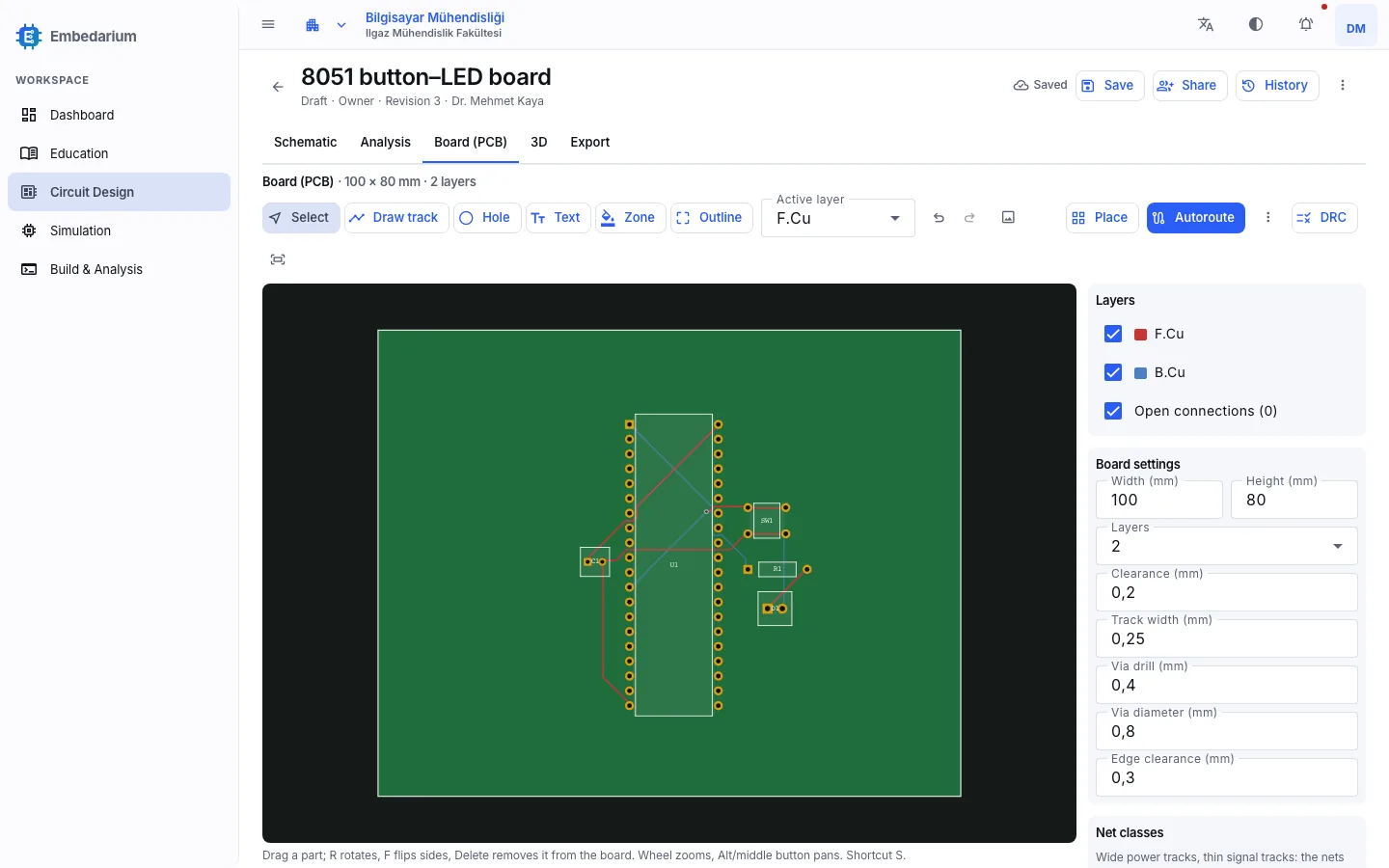
Write, build and debug microcontroller code in the browser. The simulators execute instruction by instruction at register level and count machine cycles for each target.
- 7 Target Microcontrollers: Classic 8051, classic 8052, Nuvoton MS51PC0AE (1T), Analog Devices ADuC841 (dual DAC, ADC with DMA), Microchip ATmega328P, Arm Cortex-M0+ (CMSDK reference system) and PIC16F877A.
- Cycle Counting: Each instruction advances the target's cycle count. Default clocks: classic 8051/8052 at 12 MHz (1 µs per machine cycle; MS51 and ADuC841 are single-cycle cores), AVR 16 MHz, Cortex-M0+ 48 MHz, PIC16 4 MHz (1 µs per instruction cycle); the clock can be changed per project. Pins and the circuit update at instruction boundaries.
-
Debugging: Step, step into/over/out and run to cursor (instruction or C source line); register, memory, SFR and peripheral views with editable memory; C global variable watch; conditional breakpoints (a comparison such as
R6 == 3and/or a hit count); read/write/change watchpoints; call stack, disassembly and execution trace. - Zero-Install Builds: 8051-family C and assembly build in the browser (built-in assembler or SDCC in WebAssembly; SDCC on the server is also available); AVR and Cortex-M0+ (C, with avr-gcc and arm-none-eabi-gcc) and PIC16 (C and assembly, SDCC pic14 with gputils) build on the server in an isolated toolchain container.
- Build & Analysis: Build a project revision or an uploaded ZIP on the server, with static analysis and ten selected MISRA C:2012 rules (licensed separately). Server-only builds also cover ATmega2560, ATtiny85, Cortex-M3 and Cortex-M4 (no simulation).
Example projects for every target and step-by-step guides for each architecture.
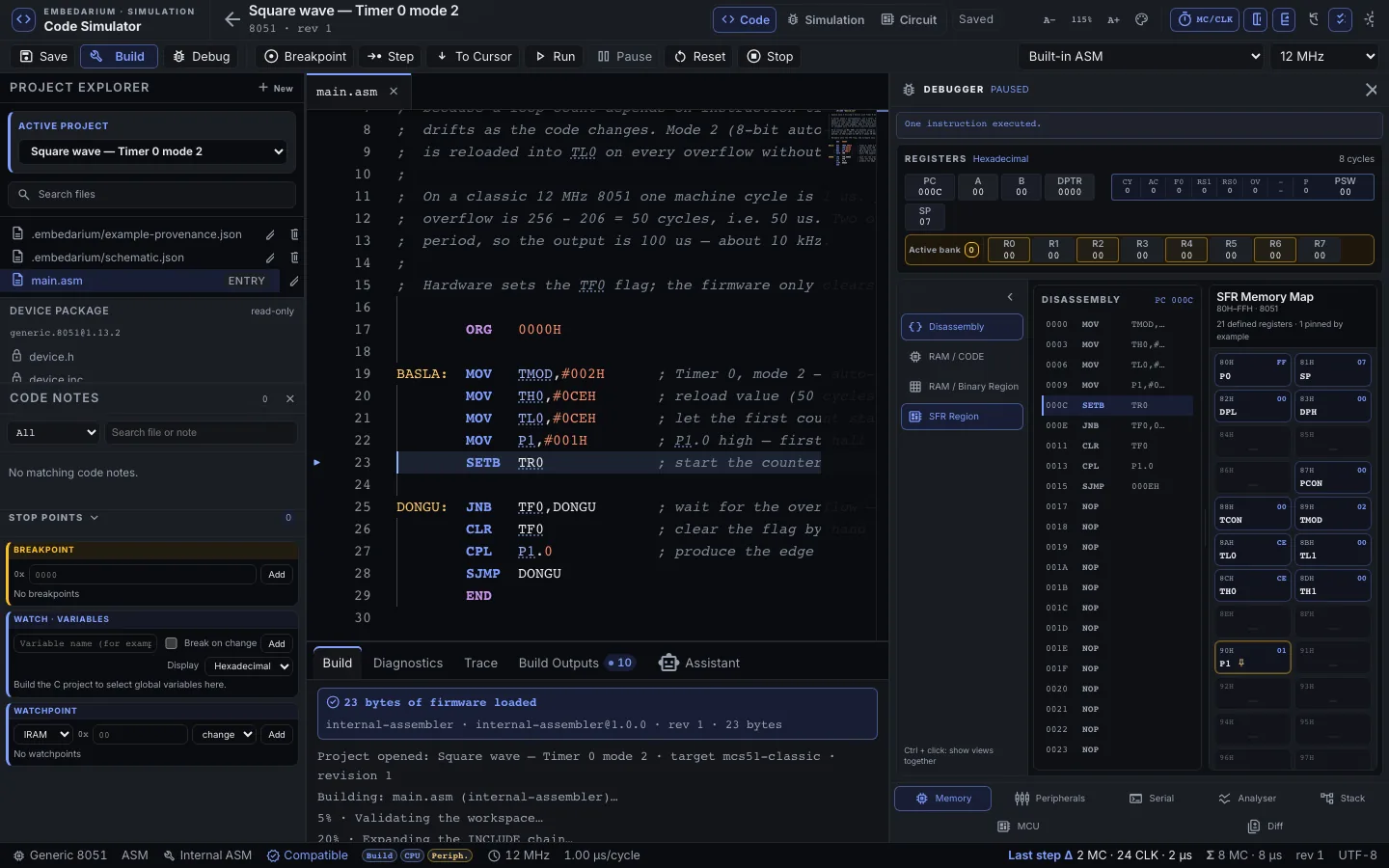
SPICE Analysis & Net Labels
Analyze analog circuits, not only logic: an in-house modified nodal analysis (MNA) solver runs the analyses on the server, and its results are compared with ngspice in tests.
- Semiconductor Models: Shockley diode (ID = IS·(eVD/(n·VT) − 1)), Ebers–Moll BJT (cut-off, active and saturation) and Shichman–Hodges MOSFET.
- Four Analysis Modes: DC operating point, DC sweep, transient response (e.g. RC, RL and RLC time constants) and AC magnitude and phase.
- Net Labels & ERC: Net labels connect distant terminals by name without drawing wires; the electrical rules check flags missing ground, shorts, unconnected pins and more.
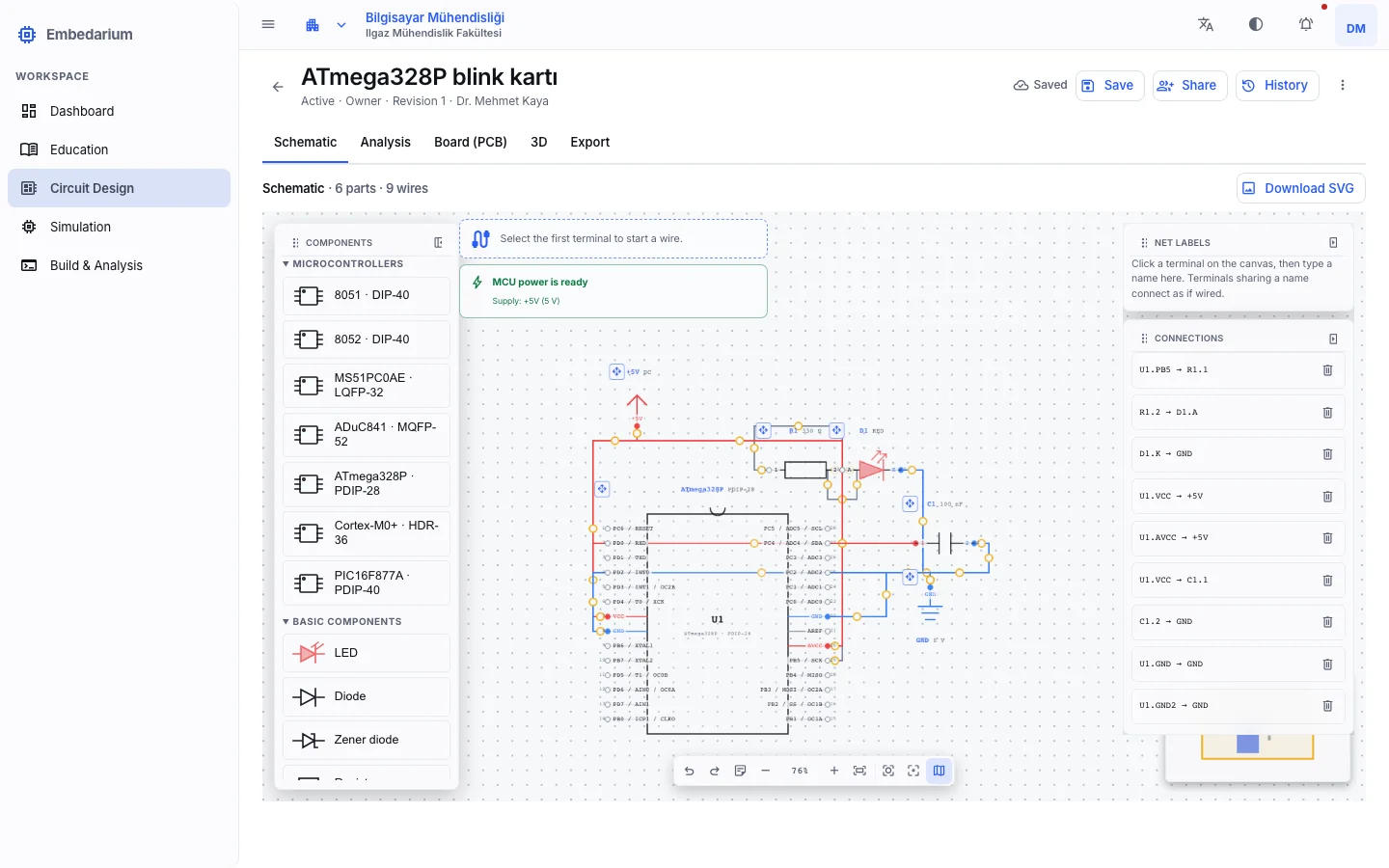
Digital Oscilloscope & Logic Analyzer
Virtual instruments modelled on benchtop equipment, for learners and engineers.
- Four-Channel Oscilloscope: Time and volts per division, trigger, channel toggles and freeze mode, with probes wired to any node.
- Logic Analyzer & Export: Digital pin timelines with frequency and duty-cycle readout; recordings export to IEEE 1364 VCD (GTKWave, PulseView) or CSV. SPICE analysis results export to CSV.
- Interactive Parts: 4×4 keypad, 7-segment display, 16×2 LCD, potentiometer, relay, DC motor and DIP switch, plus a simulated serial terminal for UART.
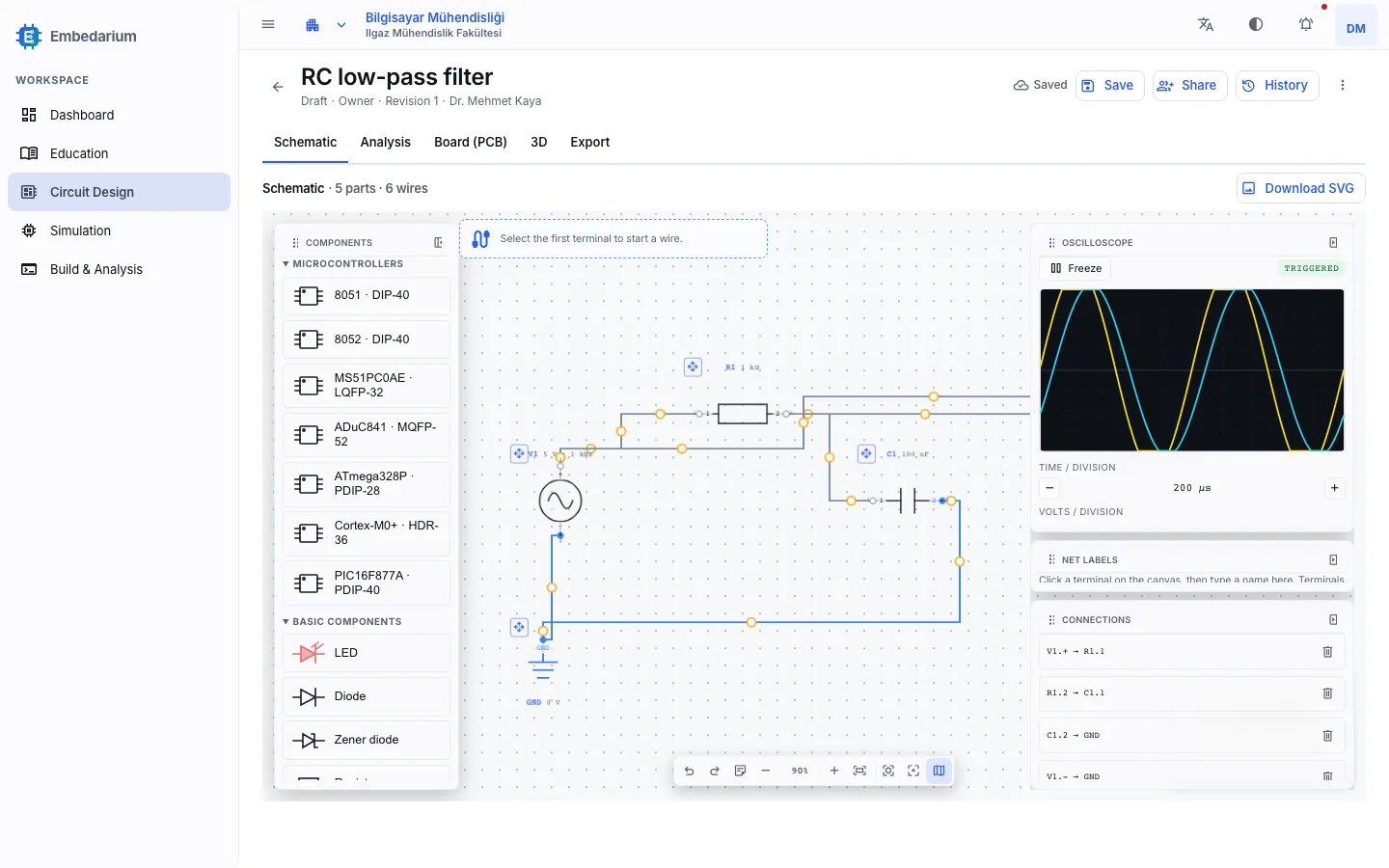
PCB Auto-Routing & Gerber CAM
Turn the schematic into a printed circuit board layout, route it automatically, check it and export the files a board manufacturer asks for.
- A* Auto-Router: A* autorouter with rip-up and reroute on 2 or 4 copper layers, design rule check and copper zones.
- Design Rule Check (DRC): Catches shorts, unrouted nets, clearance and edge-clearance violations, track width, via annular ring, overlapping footprints and silkscreen over pads.
- Standard CAM Exports: RS-274X Gerber with X2 file attributes, an Excellon drill file, Gerber job file, Bill of Materials (BOM), pick-and-place (CPL) and netlist; also a SPICE netlist and a project backup file. An isometric 3D view previews the board on screen.
Classroom LMS, Auto-Grading & Anti-Plagiarism
Run engineering coursework at scale: create lab assignments, check firmware and circuits automatically and grade consistently.
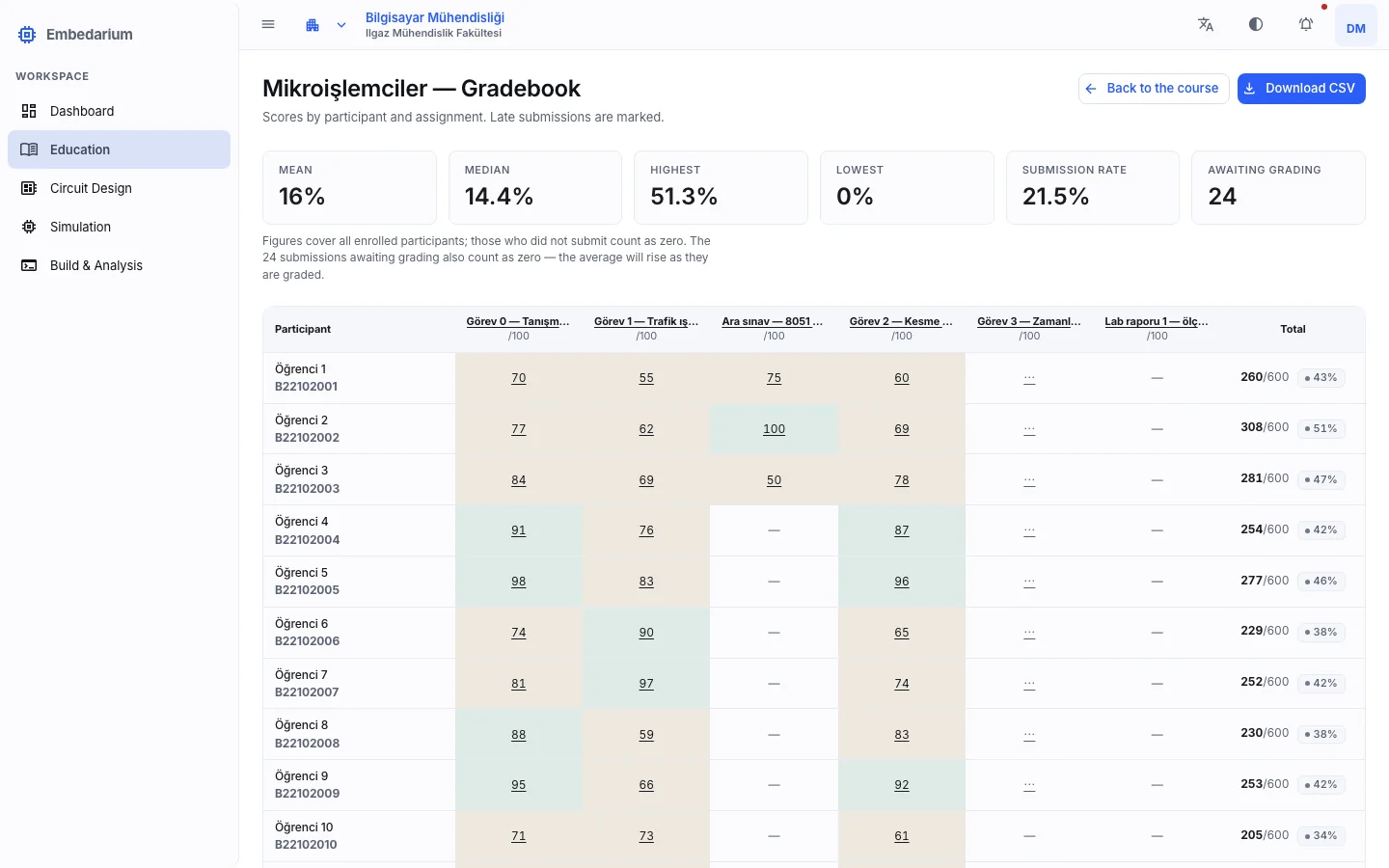
- Courses: Lesson content, invite codes and bulk enrollment, course analytics and a gradebook with CSV export; plagiarism matches are shown side by side.
- Automatic Checks: Build check, UART input/output test cases (hidden cases supported), pin waveform checks (level, period, frequency, duty cycle, edge count, DAC voltage), LCD text and netlist rules for circuit assignments; rubrics for manual grading.
- Plagiarism Detection: Winnowing fingerprints of C and assembly submissions find similar solutions even when identifiers are renamed; the instructor starts a run for a code assignment.
- LTI 1.3 & Grade Sync: Launch, Deep Linking 2.0 and grade passback (AGS 2.0) with LTI 1.3 platforms, verified in automated tests against a simulated LTI 1.3 platform (not yet tried with a production LMS, not certified); late penalties, per-student extensions and waivers.
What Embedarium Includes
A summary of the platform's capabilities. Some modules are licensed separately; see Pricing.
| Capability | Embedarium |
|---|---|
| Deployment | Web browser; self-hosted on Linux with Docker Compose |
| Microcontroller Simulation | 7 targets on 4 architectures (8051 family, AVR, Cortex-M0+, PIC16) |
| Timing | Instruction-level simulation with cycle counting per target |
| Analog Analysis | MNA solver: operating point, DC sweep, transient, AC |
| PCB (2 or 4 Layers) | A* auto-router, DRC, Gerber X2 and Excellon export |
| Automatic Grading | Build, UART, waveform and netlist checks; LTI 1.3 |
| Plagiarism Detection | Winnowing fingerprints (C and assembly) |
| Collaboration & History | Share circuit projects within your organization (viewer/editor); revision history with restore, plus a diff view for firmware projects |
| Interface Languages | English and Turkish |
Validation status
No target has been validated on physical hardware yet; uploading to a board is in beta. The emulators are checked against reference simulators (uCsim, simavr, QEMU and gpsim) in automated tests.